AddThis

3/20/04

Mexico Fought In WWII: 201st Fighter Squadron

Mexico Fought In WWII.

When German U Boats attacked and sank two Mexican ships, Mexico joined the Allies against the Axis in 1942

But, because of inadequate equipment and material, not until 1944 did President Camacho decide to send a Mexican military unit into battle. Under Col. P.A. Antonio Cardenas Rodriguez (1905-1969) the 201st Fighter Squadron was formed.

Squadron 201 was an elite, all-volunteer unit composed of the best military pilots and ground personnel in Mexico, recruited from all branches of the service.

Known as "The Aztec Eagles," the squadron flew P 47 Thunderbolts, powerful and fast, affectionately known by pilots as jugheads, and was assigned to the Pacific Theater. They flew 59 combat missions.

Here are links for information.

  • Military.com
  • US Latinos & Latinas in WWII
  • Misiones: los miembros de la Fuerza Aerea Expedicionaria Mexicana
  • 3/19/04


    Home_____Chevy Si, Cuba No

    Take 12 Cubans. Give them one 1951 Chevrolet pickup truck. Let them mount it on 55 gallon oil drums and attach a boat propeller to its drive shaft.

    Call up the US Coast Guard, which intercepts them 40 miles (65 km) from Florida, over half the distance from Cuba.

    Then repatriate them back into Fidel's arms, nine men, two women, and one child.

    The pickup was spotted by a US plane and intercepted by the Coast Guard. It had been traveling at eight miles per hour (13 km/hr).

    They were sent back under United States law, which requires that passengers must be returned home if on vessels stopped at sea. (This was a vessel? I suppose.)

    They were quite resourceful, these Cubans, having driven the truck to the beach, and making it "sea-ready" in six hours. They chose a forecast of calm seas and clear skies.

    Perez Gras told the Associated Press that if they had gotten to Key West, they could have driven it onto the sand. (Perhaps, even to Miami, after refueling, of course.)

    The Coast Guard stopped it after they had been at sea 31 hours. One Official said that the sailors couldn't believe their eyes.

    He explained that the drive shaft had been dropped from the rear axle so that it could reach into the water to turn the propellor.

    Several of the men sat atop the green truck and others were apparently under the bright yellow canopy that covered the back of the vehicle.

    One of the Cubans expressed disappointment, saying, "We thought that they would let us in because it was so outrageous."

    It had suprised the Coast Guardsmen, but not enough. The migrants were sent back to Cuba and the Chevie was sent to the bottom.

    The US Coast Guard deemed it "a hazard to navigation."

    (Derived from BBC News, 24 July 2003)

    1/28/04


    Home_____Gunslingers, Eastern Europe Style

    In the classic Western, Shane, Alan Ladd rides off into the sunset,wounded, after clearing a valley of its evil men. Little Joey, Brandon de Wilde, runs after him, shouting, "Shane! Come back Shane!" But the honorable gunman has already told the boy a man is what he is and you can't break the mold. He did what any brave man had to do, save good settlers from Ryker, the rancher-baron who would drive them off their land.

    In A Polish dictionary Shane yields this definition: a psychologically credible personification of goodness.

    In parts of communist-ruled Poland the posters billed the movie as The Man From Nowhere, escaping the censors because nowhere was code for a country overrun by aggressors for hundreds of years; it meant a nation become lost in history.

    In High Noon, as Sheriff Will Kane, Gary Cooper can't get any townsmen to stand with him on main street against the guys in black hats. He nervously checks his ammunition, looks at the clock, sees it nears high noon and his rendezvous with fate. In this 1952 classic the stakes are clear, good against evil, honor against dishonor, community against villainy.

    In Poland, out of nowhere, a lone electrician rode into town one day, name of Lech Walesa. He wore a white hat and turned his smoking oratory against the bad guys. Unlike Shane, or Sherrif Will Kane, he was a member of a community rather than a lone gun slinger. Solidarity became a mass movement.

    The image of Gary Cooper became a metaphor for the many, not the one. He strides courageously forward, ballot in hand, supported by the banner of Solidarity, headed for a showdown with the old regime at high noon.

    It was all classic black and white, them against us, good versus evil, the underdog fighting the overdog. After Solidarity, things were never again that clear. Lech Walesa assumed shades of gray and stands in dirtier hues, founding new injustices to replace those he came to remove.

    The Western itself has faded into the sunset, and is regarded as a bit corny, too unsophisticated, rather simplistic. It can't sustain itself against a post-modern world of moral compromises, deep ambiguities, and existential uncertainties.

    At one time in Poland, Western movie posters were coded emblems of subversive dissent. After 1989, newer and brighter Hollywood tales have made their way into the East, these without the mythic implications of American beliefs and values in their hey day. They reflect a new American myth, of people out for a good time, a good kill, a good snort, a good f**k, but not an America that holds anything truly dear.

    Today in Poland and the East, people like Lech Walesa would perhaps have a harder time finding suitable Hollywood counterparts in American movie posters because the posters would reveal both them and Hollywood as morally uncertain as they truly are.

    1/24/04

    Here Lies The Heart: Mercedes de Acosta and Ramana Maharshi


    Descended from the legendary Dukes of Alba, daughter in a wealthy Cuban family, Mercedes de Acosta was born in 1893 in New York, raised near Fifth Avenue, and had a beautiful sister Rita de Acosta who was a model for artists John Singer Sargent and Giovanni Boldini. Married to painter Abram Poole, Mercedes was socialite, poet, playwright, Hollywood set and costume designer as well as script writer. She knew many of the greats of her day: Bessie Marbury, Rodin, Edith Wharton, Stravinsky, Sarah Bernhardt, Elenora Duse, Picasso, Cecil Beaton, Elsa Maxwell, and Krishnamurti. Near the end of her life, she met and befriended Andy Warhol, and introduced him to many of the people who would count in his career.

    Consuelo (Hatmaker) Sides, whose husband had been the World War I French flying ace Charles Nungesser, accompanied Mercedes on her passage to India. After arriving, de Acosta met former President Woodrow Wilson's daughter, Margaret, a devotee at Sri Aurobindo's ashram.

    In 1960, she published an autobiography, Here Lies The Heart, dedicated to Maharshi, in which she wrote, To Bhagavan Ramana Maharshi, the only completely egoless, world-detached, and pure being I have ever known. She spent three days with him and remembered them as the most significant of her life.

    At a dinner party she became interested in Maharshi after she met Paul Brunton, an Englishman who had spent time with the sage, and had published A Search in Secret India, chronicling his transformative experiences at Arunachala.

    She later read Brunton's book and of it, she wrote that it "had a profound effect on me. . . . It was as though some emanation of this saint was projected out of the book to me. . . . Nothing could distract me from the idea that I must go and meet this saint. . . . . I felt I would meet the Maharshi and that this meeting would be the greatest experience of my life."

    As the car neared Maharshi's home she says,"the driver explained he could take me no farther. I turned toward the hill of Arunachala and hurried in the hot sun along the dust-covered road to the abode about two miles from town where the Sage dwelt. As I ran those two miles, deeply within myself I knew that I was running toward the greatest experience of my life."

    "When, dazed and filled with emotion, I first entered the hall, I did not quite know what to do. Coming from strong sunlight into the somewhat darkened hall, it was, at first, difficult to see; nevertheless, I perceived Bhagavan at once, sitting in the Buddha posture on his couch in the corner. At the same moment I felt overcome by some strong power in the hall, as if an invisible wind was pushing violently against me. For a moment I felt dizzy."

    "Then I recovered myself. To my great surprise I suddenly heard an American voice calling out to me, 'Hello, come in.' It was the voice of an American named Guy Hague*, who originally came from Long Beach, California. . . . " [*Some say Guy Hague is Somerset Maugham's Larry Darrell in The Razor's Edge. The Wanderling says his mentor was Maugham's inspiration.]

    After I had been sitting several hours in the hall listening to the mantras of the Indians and the incessant droning of flies, and lost in a sort of inner world, Guy Hague suggested that I go and sit near the Maharshi. . . . I moved near Bhagavan, sitting at his feet and facing him. . . ."

    "He moved his head and looked directly down at me, his eyes looking into mine. It would be impossible to describe this moment and I am not going to attempt it. I can only say that at this second I felt my inner being raised to a new level-as if, suddenly, my state of consciousness was lifted to a much higher degree. . . ."

    "[I asked Maharshi,] tell me, whom shall I follow--what shall I follow? I have been trying to find this out for years by seeking in religions, in philosophies, in teachings."

    "Again there was silence. After a few minutes, which seemed to me a long time, he spoke. 'You are not telling the truth. You are just using words--just talking. You know perfectly well whom to follow. Why do you need me to confirm it?' "

    "You mean I should follow my inner self?" I asked.

    "I don't know anything about your inner self. You should follow the Self. There is nothing or no one else to follow."

    I asked again, "What about religions, teachers, gurus?"

    "If they can help in the quest of the Self. But can they help? Can religion, which teaches you to look outside yourself, which promises a heaven and a reward outside yourself, can this help you? It is only by diving deep into the spiritual Heart that one can find the Self."

    "He placed his right hand on his right breast and continued,

    Here lies the Heart, the dynamic, spiritual Heart. It is called Hridaya and is located on the right side of the chest and is clearly visible to the inner eye of an adept on the spiritual path. Through meditation you can learn to find the Self in the cave of this Heart. . . ."

    "Bhagavan pointed out to me that the real Self is timeless. 'But,' he said, 'in spite of ignorance, no man takes seriously the fact of death. He may see death around him, but he still does not believe that he will die. . . .' "

    "To write of this experience with Bhagavan, to recapture and record all that he said, or all that his silences implied, is like trying to put the infinite into an egg cup. . . . On me he had, and still has, a profound influence. . . .I definitely saw life differently after I had been in his presence, a presence that just by merely 'being' was sufficient spiritual nourishment for a lifetime. . . ."

    "I sat in the hall with Bhagavan three days and three nights. . . . I wanted to stay on there with him but finally he told me that I should go back to America. He said, 'There will be what will be called a "war," but which, in reality, will be a great world revolution. Every country and every person will be touched by it.' You must return to America. Your destiny is not in India at this time.' . . . ."

    "Bhagavan Ramana Maharshi died on April 14,1950. He had said, 'I am going away? Where could I go? I am here.' By the word 'here' he did not imply any limitation. He meant rather, that the Self 'is.' There is no going, or coming, or changing in that which is changeless and Universal. . . . millions in India mourned the Maharshi. A long article about his death in the New York Times ended with, 'Here in India, where thousands of so-called holy men claim close tune with the infinite, it is said that the most remarkable thing about Ramana Maharshi was that he never claimed anything remarkable for himself, yet became one of the most loved and respected of all'."

    Her meeting with Maharshi was perhaps most remarkable in view of her life that preceded it. Alice B. Toklas once said of her, "you can't dispose of Mercedes lightly, she had the two most important women in US., Greta Garbo and Marlene Dietrich." Other lovers of Mercedes included the great actresses Alla Nazimova and Eva Le Gallienne and the legendary innovator of dance, Isadora Duncan. "I can get any woman away from any man," she liked to tell her friends. But what de Acosta eventually wanted more than anything was the 1938 interview with Ramana Maharshi. A woman of great appetites, she sought somebody who taught the quenching of appetites.

    Mercedes de Acosta moved to a 68th Avenue apartment and died in relative poverty in 1968. In her autobiography she had revealed too many secrets about her friends, who then cut her out of their circles.

    Her book, Here Lies The Heart

    1/21/04


    Home_____Sex Crimes In The Distant Past

    In Sex Crimes: From Renaissance to Enlightenment, William Naphy reveals that kinkiness has a long history. In 16th century Geneva, despite the effort of John Calvin to settle a repressive pall over the city, people looked for prurient pleasure wherever they could find it. Drawing on official court reports, Naphy shows the reader that sex crimes took a rather bizarre turn even then.

    About 10,000 in population, Geneva had its morality presided over by about a dozen elders and the same number in ministers, always looking for behavior "tending towards fornication." This included somebody singing a bit too bawdily, even if only to themselves. A Genevan could be charged with a sex crime if dancing at a wedding. If an individual smiled too boldly at a stranger, he or she could be brought before the tribunal. Citizens were encouraged to spy on one another and report anything that even seemed like odd behavior. This must have been the hey day of busy bodies and voyeurs. Those who held grudges or were downright malicious also had wonderful opportunities. Court records show many situations in which spite, greed, and unrequited love were the causes of innocent people being charged with sex crimes.

    Unmarried pregnant girls often wound up in court. They could not claim they were raped because they had to have an orgasm in order to conceive--so went the thinking. Thus, even if forced, a pregnant girl must have enjoyed it. If she named a long-time lover as the father, both risked probable imprisonment.

    Adultery was also taken seriously as it threatened the marriage with a false heir to property. In Calvinist Geneva, money and business matters were taken seriously indeed, so much so that both the woman and her partner were likely to be executed. Given their choice, the condemned usually chose drowning. If a male servant committed adultery with his mistress, he frequently was executed because he had robbed his master of a valuable asset. The effect of economics went far to lessen a crime if the male adulterer was equal in social and economic stature to the cuckolded husband. He would be flogged and banished. (Eventually authorities realized that some people found flogging as sexually exciting, and they stopped it as punishment.)

    Homosexuals were officially nonexistent. Acts of sodomy occurred, and were punishable by death. Even though homosexuality was not recognized, defense would take the form of one person pointing out that he had a wife and four children. The prosecution would argue that the offender had habitually committed offenses with other men.

    In 1551 Jean Fontanna and Francois Puthod were arraigned before court for "wrestling in the nude." Fontanna explained that their relationship began when he noticed Puthod "had an enormous member." Much younger, Puthod tearfully pleaded that he hadn't realized he did anything wrong. He was banished from the city. Fontanna, with a wife and child, had a long history of nude wrestling and was chained to a large stone for a year and a day.

    Despite the stern godliness of John Calvin, 16th century Geneva was no bastion of high morality. Overcrowded quarters meant that children regularly witnessed parents engaged in sex. Single men shared beds. Peasants lived intimately with animals. In 1660 a cowherd told the court he wasn't having sex, but had merely urinated over the cow's behind to rid it of parasites. He was acquitted.

    In 17th and 18th century Britain, homosexuality had effeminacy as its characteristic. Fops paraded it and even heterosexuals adopted the pose as entree to certain artistic or thespian cliques. Effeminacy became camp. In the early 18th century Margaret "Mother" Clap became proprietress of a molly house, and she left her name as a lasting sign of those venereal times. In Samuel Stevens' testimony at her trial he stated he saw, "40 and 50 Men making Love to one another, as they call'd it. Sometimes they would sit in one anothers Laps, kissing in a leud Manner, and using their Hand[s] indecently. Then they would get up, Dance and make Curtsies, and mimick the Voices of Women."

    Homosexuality had moved into the open, and unlike Geneva, had to be officially recognized. Sodomites were put in stocks and blinded with cow dung.

    In our relatively more enlightened times, the public and the authorities still struggle with how to define and legislate such matters.

    Sex Crimes by William Naphy at Amazon.co.uk

    1/20/04


    Home_____It's a bird! It's a plane! No! It's Angle Grinder Man

    As Andy Warhol Said, Everybody Gets His Fifteen Minutes of Fame. Now It's Angle Grinder Man's Turn.

    Some people call him a Clark Kent lookalike. You can tell the difference, however. He has an AGM logo on his chest, not an S. He also helps damsels in distress. He certainly has a sense of humor.

    In a 7 October 2003 New York Times article, the masked man gave an interview. Calling himself Angle-Grinder Man, he comes to the rescue of those whose car wheels have been booted by police for illegal parking. The New York Times reporter described him as dressed in cape and gold lamé underpants.

    He has become a folk hero of sorts among frustrated South London motorists. He takes his name from an Angle Grinder, a power saw that cuts through wheel boots, Whenever he turns on his loud saw, people know he's around, but he always insures the police are absent. No matter--in less than a minute he can liberate a wheel from the clutches of authority and earn the undying gratitude of drivers who escape their fines.

    Just like Superman and The Lone Ranger, he accepts no money for his deeds, as he is merely on the side of the little guy. He hides his identity behind his mask, and the public doesn't know, much as nobody suspected the mild mannered reporter Clark Kent. Like the Lone Ranger, he strides off into the sunset and townsmen turn to one another and ask, Who was that masked man?

    A damsel in distress, Petite Tendai, found a boot on her illegally parked car. ("No signs saying `no parking,' " she declared.) She felt the weight of injustice and authority almost bringing her to tears when suddenly Angle-Grinder Man appeared.

    Since then, he has become Ms Tendai's hero.

    Ms Tendai said of him, "Basically, he jumped out of his car in his outfit and said, `If anyone can, Angle-Grinder Man can,' " She added, "Then he just started sawing it off. It was wicked."

    He was brought to his noble duty by a boot clamped onto his own car wheel, and insult was added to injury by a £95 fine (a little over $150) to remove it. He did what any Robin Hood would do, renting a circular saw for about £30. Unemployed, he saved himself a hunk of change.

    An extremely sensitive nature

    He taped a photograph of the sawed-up clamp to his windshield, along with a note saying, "Please don't clamp me because I've got an extremely sensitive nature."

    From that day forward, Angle-Grinder Man had found his calling. "There was so much injustice out there," he said.

    A champion of the downtrodden must look the part. He worked hard on his appearance, but finally settled on blue and gold. He bought a fabric roll of gold lamé at a flea market after holding the material around himself to ask the salesgirl how he might look in it.

    He spray-painted a pair of cowboy boots gold. The underpants are a pair of bikini briefs covered with the flea-market lamé. The gloves came from a piercing-and-fetish shop. Angle-Grinder Man designed the logo himself, including the letters AGM glued on his costume. "I wanted to have a balance between the political side and the comedy side," he explained.

    "I'm a heterosexual superhero," Angle-Grinder Man told the reporter, "although I have no problem being a gay icon."

    As he left the interview his gold cape glittered in the afternoon light. Unknowingly he had smitten the heart of another damsel who had been watching him. A sales clerk said she was a great fan of his.

    "I think he's extraordinarily attractive," she said. "Especially the golden knickers."

    12/24/03

    Feral Children: John Ssabunnya, Kamala and Amala, Hessian Wolf Boy, Wild Boy of Averyon


    Feral Children

    Found in 1991, John Ssabunnya (pictured here) was reared by apes in the jungles of Uganda. Seeing his mother murdered by his father, John escaped into the jungle as a toddler, where Green monkeys adopted him and thereby saved his life. John learned their mannerisms, climbed trees, lived on fruit, nuts, roots, and berries.

    To protect themselves, John and his monkey family made racket, and hurled sticks at John's would-be rescuers. When the villagers got the boy down from a tree, they found him covered with dirt, his eyes and body filled with fleas.

    Raised in a Christian orphanage, John learned again how to speak and told his story. For those who were skeptical, he demonstrated behavior that put their doubts to rest.

    The BBC tested John by taking him to the Uganda Wildlife Education Center. With a group of visiting children who harassed Green monkeys, John behaved differently. Crouched, and reaching an open hand toward the monkeys, he made a series of oblique glances and guttural sounds that left the humans in awe. In less than two hours he had been accepted by the monkeys.


  • The Hessian wolf-boy, found in the woods of Hesse, Germany, in 1341 and raised thereafter by local monks whose records indicate he was about 7 years old and kept by wolves. He soon died after capture but a second boy, about 12, was captured in the same region in 1344. This boy apparently died soon after being captured, but a second wild boy — this time a 12 year old — seized three years later (1344) in the same region but the woods of Wetterau this time and lived to the age 80. Records indicate both children as wild and immune to cold and discomfort, besides not being able to stand upright, consequently having to move around on all fours.
  • The Wild Boy of Hesse, captured in the woods near Hameln, Germany 27 July 1724, about 12 years old. He could not speak and ate only vegetables and grass and sucked the juice of green stalks; at first he rejected bread. Summoned to King George I (also Hanoverian King), he was briefly court favorite, dying in 1785.
  • The Wild Boy of Aveyron, captured near Lacune, France, 1797 and taken, kicking and screaming, by local peasants then displayed in the village square. He escaped and was recaptured in 1798. A widow fed and clothed him for a week, but he again escaped to the forest. Less wary of humans, in the 1800 winter, hungry, he wandered into Saint Sernin and was captured again. Dirty, inarticulate, he moved on all fours, grunting like a beast. He became known as Victor. Bonaparte's brother, Lucien, ordered Victor to Paris and exhibited him in a cage, wherein he rocked back and forth, dull, lifeless, apathetic. Jean-Marc Gaspard tried to educate him. Victor learned how to read, say a few words, and obey simple commands, but never spoke properly. He died in 1828.

    Interestingly, this was Rousseau's age, the epoch of nature as pure and civilization as degrading. The boy put to the test such beliefs. Victor was no Garden of Eden child.
  • Kamala and Amala  Kamala, 7 or 8 years old, and Amala, about 1 and a half, were two girls supposedly discovered in 1920 living with a family of wolves in a cave-like den in the base of a huge abandoned termite hill in India. In an orphanage, they preferred the company of cats and dogs, and like wild animals, slept days and prowled nights on all fours. They bit and attacked other children if provoked. With acute sight, hearing and smell, they enjoyed raw meat. In 1921 Amala died. Kamala would not leave her sister's body and had to be removed from the coffin. Kamala learned a small vocabulary and died in 1929.
  • 12/21/03

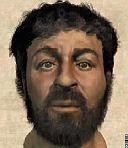
    Jesus' Face Reconstructed


    With the aid of computers, forensic anthropologists input the best data available for Jesus in his time and place. This representation differs markedly from the European version of him as lithe, long-haired, light-skinned, and delicate-featured.

    Israeli and British scientists worked with computer programmers to create the face for the December 2002 Popular Mechanics magazine.

    They used archaeological and anthropological science rather than an artistic interpretation. Following a model of a skull found near Jerusalem that dates to the first century, they performed CAT scans and forensic muscle reconstruction to recreate the face. They acknowledge that without Jesus' skull, theirs is not the actual face, but it does come much closer than previous artist renderings, which were filtered by the culture of the painter.

    It is a broad, peasant's face, dark olive skin, short curly hair, and a prominent nose. People were much shorter in Jesus' time, so he would have stood about 5 foot 1 inch tall (1.55 m) with a weight of 110 pounds (50 kg).

    Unlike paintings, his hair is short. The researchers found that in the Bible long hair was not customary, and was frowned upon. In the New Testament Paul wrote "If a man has long hair, it is a disgrace to him."

    It may not be great art, but is less misleading as to the appearance of the true face.

    12/19/03

    Chris Langan & His IQ


    Chris Langan is one of the smartest people in America—his reported IQ is said to be off the charts. Yet, if it's a criterion of anything at all, he has not made it big in the business world. At the time this is written he’s in his mid 40’s, works as a part-time bouncer at a bar and lives in a one room home. He claims that he manages to support himself on only $6000 a year.

    From a modest background, Chris had an abusive father. His exceptional intelligence only seemed to heighten the problems in their relationship.

    Langan says that being a genius does not necessarily make life easy. Although he has never cared much about money, he explains that his lack of a consistent and professional career path is a result of negative experiences in school.

    The following is excerpted from On 20/20 Downtown, no date given, in which Cynthia McFadden moderated for Langan, who answered questioners. The account states that he is working on a mathematical and philosophical book that will present his theory of the universe.

    As an online chat Langan answered posted questions.

    Questioner--How do you think you can prove the existence of God using mathematics?

    Chris Langan--You have to prove that the universe is a self-referential system. Then you have to examine the attributes of this system, analyze the system to determine how it behaves. It turns out that in certain ways it behaves mentally like a mind. The natural question to ask then is: whose mind are we talking about? The answer to that question is the mind of God.

    Questioner--What is the correlation between genius and IQ? between motivation and IQ?

    Chris Langan--There appear to be aspects of motivation in intelligence. Whether or not these show up in IQ depends on the test that is taken. For some tests, motivation is a factor; for others it isn't. The ones for which motivation is not a factor, are those that tend to measure mental reflexes. However, even mental reflexes can be depressed for a variety of reasons. So if one's motivation is lacking, one should always be retested when it's high.

    Questioner--What is the extent of your education? Did you ever go to college? Why or why not? If you did, how did your relationship with other people change?

    Chris Langan--I graduated from high school. I got an academic scholarship to college which lasted for one year. Lost it due to a bureaucratic oversight, and paid my own way back to college for a little under 2 quarters after that. By that time, I'd had a sufficient number of negative experiences in academia that I didn't want to go back. However, although I remain disappointed with academic bureaucracy, I understand that it's a system from which some people have much to gain.

    Questioner--Have you read any Hindu or Buddhist texts relating organization of the universe? I've read that similiar texts have inspired Tesla.

    Chris Langan--Yes I have read such texts, and have found remarkable insights in them, and yes I have been inspired by them.

    Questioner--Are you a member of MENSA?

    Chris Langan--No. I never joined Mensa. The first high IQ society I joined was the Mega society, with a much higher cutoff than Mensa's. Whereas Mensa has a cutoff of 1 in 50, the Mega society has a cutoff of 1 in 1 million. Subsequently I joined the Prometheus Society which has a cutoff of 1 in 30,000 and the Triple 9 Society which has a cutoff of 1 in 1,000. Together, these and other high cutoff societies form what is called the Superhigh-IQ Community. The Mega Foundation is working to develop the Superhigh-IQ Community on a global level.

    Questioner--Does language limit our thought?

    Chris Langan--Most people think that a language must be a natural, spoken or written language like English, French or German. But in mathematics and logic, the definition of language is far more general. Reality itself can be viewed as a language, and the language of thought is closely related to that of reality at large. So we might just as well say that the language of thought, rather than limiting our ability to understand reality at large, facilitates it. However, if one's mental language is artificially constrained, then one's insight and creativity may indeed be impaired. The surest proof against this is an open mind and a desire to learn. Samuel--Hi Chris, you mentioned that the universe behaves in certain ways like a mind. Can you elaborate on this?

    Chris Langan--The mind works according to the principals of mathematics, including inductive and deductive logic. This goes back to Kant who held that the human mind has categories of perception and cognition. These categories are constraints on phenomenal reality. But phenomenal reality is the only reality we can know. Therefore, constraints on mind function as constraints on reality and systems that function according to similar constraints are similar in function.

    Questioner--Chris, Do you believe in creation science or evolution?

    Chris Langan--I believe in the theory of evolution, but I believe as well in the allegorical truth of creation theory. In other words, I believe that evolution, including the principle of natural selection, is one of the tools used by God to create mankind. Mankind is then a participant in the creation of the universe itself, so that we have a closed loop. I believe that there is a level on which science and religious metaphor are mutually compatible. Questioner--Do you play an instrument, draw, paint, etc??

    Chris Langan--Yes I do. My main instrument is the guitar. I own several electric guitars including a Les Paul, and a Gibson bass guitar. I've also played the piano, although I took it up too late to be especially good at it. I own a synthesizer, that is an electronic keyboard. In fact, I've even played the drums! Most recently I've been into composing music on my computer. There are now a number of good programs that will let you do this. In addition, I draw and occasionally sculpt. I've also written a novel or two, now molding in the bottom drawer of my desk and I love to write songs and poetry. I guess I'm just a romantic at heart.

    Moderator of questioning--Chris do you have any final thoughts?

    Chris Langan--I'm very concerned about helping others who face some of the problems that I faced when I was growing up. That's what the Mega Foundation [an organization he founded] is about--gifted people helping gifted people. The profoundly gifted are the greatest and most cost effective resource that we as a species possess, and we should do everything in our power to see that they are not wasted. At the same time, every human being, regardless of IQ, has a microcosm in his or her mind and the abilities of ordinary people are in a sense as important as those of the gifted. If we all work together to solve the world's problems, future generations of mankind will have a much healthier planet to inherit

    12/12/03


    Home_____Fear and Loathing in Manilla

    On 6 July 2001, from Manilla’s AM sports radio station DZSR Bobby Fischer did karaoke over Jackie Wilson’s "take it from me,don’t ask for a helping hand, mmm ‘cause no one will understand!" Yes, Bobby was on a roll. "Bright lights will find you, and they will mess you around! Let me tell you, millions will watch you! Have mercy now, as you sink right down to the ground!"

    Poor Bobby, he had to hide in Manilla to sing that. Nobody in New York would understand the plaint behind his lyrics. He had gone to the Philippines to escape a world that didn’t appreciate him, lured there by Sports Radio management who, in exchange for interviews, gave him free air time for his classic Rhythm and Blues disks. This was his seventeenth Philippine radio broadcast and he used them to lash out at his enemies, former New York City mayor Ed Koch, Presidents Bush, junior and senior, and the Times Mirror. They were all "Jews, secret Jews, or CIA rats who work for the Jews."

    Bobby complains that he is being persecuted by world Jewry.

    His mother was Jewish.

    Because of the United States government he claims he has been forced into exile. Because of book publishers, movie studios, and clock manufacturers, he has been swindled out of a fortune in royalties, brand name copyrights, and patents.

    As for chess, why it is nothing more than "mental masturbation." Gary Kasparov is a crook and former KGB spy who won’t sign up to an honest match. He makes sure all outcomes are rigged.

    On 11 September 2001, the day thousands died, some by leaping out of eightieth story windows, Fischer was interviewed on Bobo Radio, a public station in Bagnio City. "This is all wonderful news," he told his interviewer. "I applaud the act. The US and Israel have been slaughtering the Palestinians, just slaughtering them for years. Robbing them and slaughtering them. Nobody gave a shit. Now it’s coming back to the US. Fuck the US. I want to see the US wiped out."

    Misery caused him by the US is one thing, but worst of all is that the Jew Rothschilds, the closet Jew Clinton, and the probable Jew Bekins executives, have devastated him.

    Bekins did it by stealing millions of dollars of material from his ten-by-ten foot storage space in Pasadena, California.

    Childish? Acute paranoia? Slippery hold on reality? Deranged?

    What about the royalties? All U.S. book royalties have been paid, although in escrow in California since 2000 as Fischer has not given a taxpayer-ID. A movie such as Searching for Bobby Fischer can use his name and persona without his consent. The "Fischer Method" chess clocks were not authorized by him, but then, he hasn’t filed suit.

    What about the storage space heist? Bekins sold its contents at public auction because Fischer didn’t keep up his rental payments.

    The storage room held old magazines, Mexican comics, John Gunther books, and nothing worth millions of dollars.

    In fact, a Good Samaritan, Bob Ellsworth, bought up the lot at the Bekins auction and shipped it all to Fischer when he lived in Budapest. A receipt exists to that effect. Fischer denies it.

    Of Ellsworth, Fischer said during a 27 January Philippine radio interview, "Some Filipino who loves me should say hello to that motherfucker. Bob Ellsworth is worthy of death for this shit he pulled on me in cahoots with Bekins. This was all orchestrated by the Jewish world governments."

    In a more recent radio interview he urged the Icelandic government (yes, the Icelandic government) to close the local U.S. naval base. "If they refuse to go," he said, "send them some letters with anthrax. They'll get the message."
    ___________________________

    Information for this piece derives from the December 2002 issue of The Atlantic Monthly's article titled "Bobby Fischer's Pathetic Endgame" by Rene Chun